
Taking Stephen's Story to Parliament House
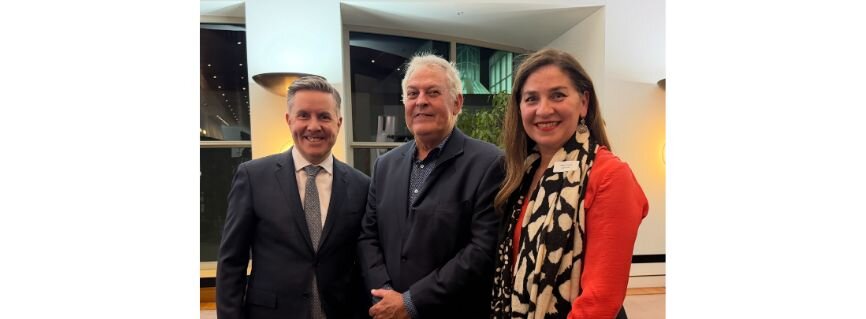
When Cardihab CEO Helen Souris walked into Parliament House for Medtech on the Hill, she carried with her the stories of thousands of Australians who have completed cardiac rehabilitation from home. Stephen Fabbro’s was one of them. This is what happened when those stories reached the people with the power to change the system.
What is Medtech on the Hill?
Medtech on the Hill is the Medical Technology Association of Australia's (MTAA) annual Parliamentary engagement program, bringing medical technology companies face to face with Members of Parliament across all parties to make the case for policy and funding reform.
This year, Cardihab was part of that conversation. Our CEO Helen Souris met with Members of Parliament from across the political spectrum, including Mark Butler, Federal Minister for Health and Ageing. The focus of those discussions was one of the most important unresolved questions in Australian digital health: why are evidence-based digital therapeutics still not adequately funded, and what will it take to change that?
The case we took to Canberra
The cardiac rehabilitation access gap is one of the clearest examples of a system failing to fund what it knows works.
568,000 Australians are hospitalised with a cardiac diagnosis every year. Every one of them should have access to cardiac rehabilitation. The evidence is unambiguous: it reduces cardiovascular mortality by 26%, cuts hospital readmissions by 18%, and improves quality of life and long-term survival.
80% of them never access it.
The estimated cost of that gap is $2.2 billion annually in avoidable readmissions. We are spending $9.2 billion on CVD hospital services while leaving the majority of eligible patients without the follow-up care that would reduce their risk of coming back.
The solution is not a new one. Digital cardiac rehabilitation programs, validated by independent research, delivered through regulated platforms, are already demonstrating what is possible. The Baker Heart and Diabetes Institute's evaluation of Cardihab, published in the European Heart Journal, showed +1.434 quality-adjusted life years per patient at $14,302 per QALY. Hospital bed day reductions of up to 71% in the first 90 days post-discharge. 91% program completion.
The technology is class IIa TGA-registered. The clinical evidence is peer-reviewed. The regulatory framework is in place.
The blocker is funding. And that is exactly what this years conversations at Medtech on the Hill tried to address.
Stephen Fabbro
Data tells the policy story. But it is people like Stephen Fabbro who make it impossible to look away.
Stephen is a sugarcane farmer who has worked his own land in Home Hill, North Queensland, for thirty years. Home Hill is a small town roughly halfway between Townsville and the Whitsunday Islands. The nearest major hospital is 120 kilometres away in Townsville.
About three years ago, Stephen started experiencing chest pain after heavy work on the farm. He put it down to age and fitness. His kids pushed him to get it checked. His GP referred him to a cardiologist in Townsville. Tests revealed significant narrowing in his coronary arteries.
He was told he needed a triple bypass. The primary blockage was in his left anterior descending artery, known as the LAD, or more commonly as the widow-maker, because of how much of the heart muscle it supplies. What he thought would be a day procedure became open heart surgery at the Mater Hospital in Townsville. He spent two days in intensive care.
Stephen's father had died of heart problems at 56, in 1981, when Stephen was eighteen. His father had not wanted to travel away from the farm for treatment. He did not get it.
Stephen knew what was at stake.
"Looking back, that operation saved my life. I feel incredibly lucky that I didn't have a heart attack."
After surgery, while still in his hospital bed, Stephen was offered the Cardihab virtual cardiac rehabilitation program. His wife was recovering from foot surgery at the same time. He was not allowed to drive for six weeks. Travelling 120 kilometres to Townsville for repeated in-person rehabilitation sessions was not a realistic option.
He said yes to the app, not really knowing how helpful it would be.
He completed his full rehabilitation program from his lounge room, then from his yard, then from wherever he happened to be with his phone. He participated in virtual group sessions with other patients from different towns, supervised by a physiotherapist. Sometimes the sessions ran long because people were talking honestly about what recovery actually felt like.
He was back at work on the farm after eight weeks, starting with light duties. He still has the app. He uses it every day to record his blood pressure, weight and exercise, and to track his medication.
"I honestly don't think I would have recovered as well without the support, and it also saved me a lot of time, travel, and stress."
After a newspaper article about his experience was published in the Townsville Bulletin, people Stephen knew in similar situations reached out, wanting the same option. They had not been offered it. For many of them, the distance to Townsville would have made traditional cardiac rehabilitation impossible.
Why his story matters
Stephen's story is not unusual. It is the everyday reality for patients in regional and rural communities across Australia who are discharged from hospital without a practical pathway into cardiac rehabilitation.
He represents every patient who has ever been told that the service exists but is too far away, too inflexible, or too difficult to reach during recovery. He represents the 454,400 people who, every year, are part of the 80% who miss out.
The difference in his case was that someone offered him the app before he left the hospital. That single act, at that single moment, changed the trajectory of his recovery.
That moment should not be the exception. It should be standard practice, at every discharge, for every eligible patient, funded as a routine component of cardiac care.
Stephen only had access to Cardihab because of pilot funding from the then Department of Tourism Innovation and Sport. When the pilot funding finished so did access to the program
What we are asking government for
We need a fit for purpose funding mechanisms for digital therapeutics and remote patient monitoring solutions.
The MTAA has published a detailed report on the funding gaps affecting digital therapeutics and remote patient monitoring. MTAA DTx and RPM Funding Report 2026
It outlines the patient, health system, and industry impacts of those gaps, compares international reimbursement models, and makes specific recommendations for how Australia can close them.
The conversations at Medtech on the Hill were encouraging. There is growing awareness of the funding challenges that inhibit digital health adoption and the need for reimbursement to unlock the potential of these solutions.
For Stephen, and for the hundreds of thousands of Australians in situations like his, access to evidence-based cardiac rehabilitation should not depend on geography, transport, or the timing of a hospital offer. Digital health solutions should be a standard part of what the system provides.
We know how to deliver it. We have the evidence. We have the technology. We have the regulatory framework.
We need the funding to follow.