
Half the population, fraction of the funding
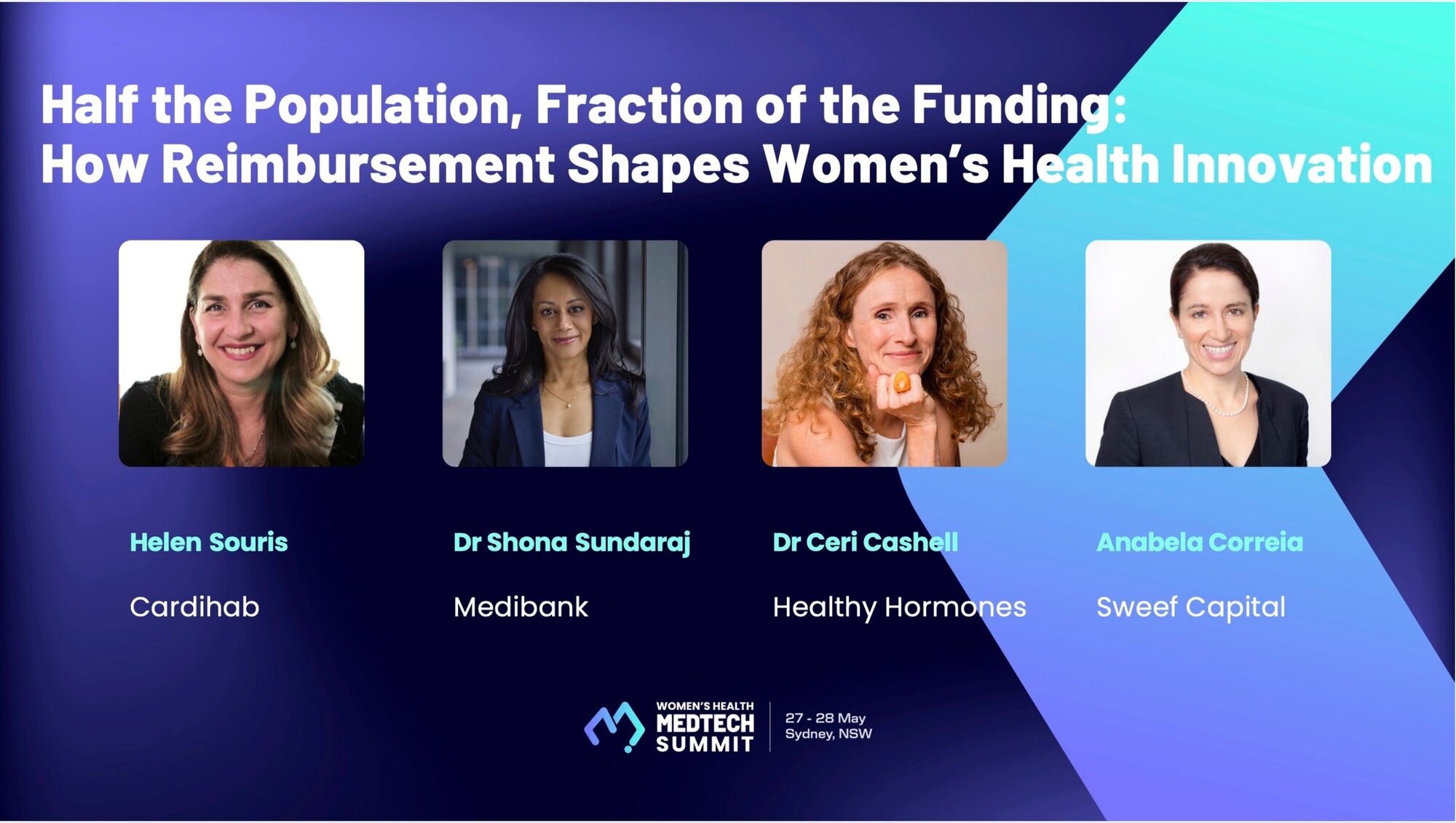
At the MTAA Women in MedTech conference, our CEO Helen Souris moderated a panel that talked to the session title and highlighted the concerning observation that transformative change in women’s health seems to arrive in 20 years batches - too long - and what will it take to close that gap?
Throughout the first day of the summit, we heard from every session, how the health system we have was built and designed on clinical trials and data - and concerningly, what is now being used to train AI - on the treated male biology as the default, with female experience as the exception. Women’s conditions were considered more complex, unspoken, unresearched, sometimes dismissed outright.
But the purpose of this panel discussion was not to focus on the flaws of the past - it was to shine a light on examples that have transformed women’s health and what we might do as a collective to further equality in healthcare for women.
The session opened with the scope definition and a reinstatement of the number one women’s health problem - heart disease, not breast cancer. It is the number one killer of Australian women. Autoimmune conditions affect women at twice the rate of men. Endometriosis costs the Australian economy an estimated $9.7 billion a year. And yet, in 2023–24, just 3.3% of Australian government health research funding was directed to women’s health.
The panel traced a recurring pattern across Australian women’s health policy: change that was scientifically possible - and in many cases urgently needed - arriving only after decades of sustained external pressure. Dr Helen O’Connell’s landmark anatomical research, published in 1998, took more than 20 years to enter medical ethics literature as a standard case study. GST on menstrual products, introduced in 2000, wasn’t removed until 2019. Hormone replacement therapy treatments backed by strong evidence weren’t listed on the PBS until March 2025 - only after a Senate inquiry forced government action.
The session didn’t stop at the diagnosis. It asked what it actually takes to end the pattern.
The panellists
Helen Souris
CEO & Executive Director, Cardihab · Moderator
Helen leads Cardihab, a digital cardiac rehabilitation platform delivering programs to patients across Australia and internationally. She brings a systems-level lens to women’s health - shaped by years at the intersection of clinical evidence, reimbursement policy, and health technology commercialisation.
Dr Shona Sundaraj
Group Medical Director Medibank
A physician and health system thinker with expertise in prevention, research, primary care, and what upstream investment in women’s health initiatives could look like in practice.
Dr Ceri Cashell
Founder, Healthy Hormones
A practising GP and founder of Healthy Hormones, Ceri works at the clinical coalface of hormonal medicine and digital health.
Anabela Correia
Sweef Capital
Anabela works directly with founders building women’s health businesses, advising on strategy and investment readiness. She brings a frank perspective on why female-founded companies are structurally disadvantaged in funding markets - and what needs to shift for the calculus to change.
What the Panel Covered
What Women’s Health Actually Is
The conversation opened by widening the frame beyond reproductive health to cardiovascular disease, autoimmune conditions, neurology, and mental health. Conditions where female biology is the norm, not the exception, and where the gap between burden and investment is often widest.
Where the Money Flows — and Where It Doesn’t
The panel unpacked “funding” as several distinct streams: government research grants, PBS and MBS reimbursement, private health insurer procurement, industry R&D, and out-of-pocket consumer spend. Each has its own failure modes - and collectively they shape what gets built, what gets prescribed, and who bears the cost.
The Investment Room
Globally, female-founded companies have historically received around 2% of total venture capital. Some startups are choosing to bring men’s health products to market first - not because the product is better, but because it is a safer funding bet. The panel examined what it takes to shift that calculus.
The AI Data Problem
Decades of male-default clinical trial design means the datasets now training AI clinical decision tools carry the same bias forward. Women were excluded from many clinical trials until the early 1990’s. The window to correct this is open – and validated, regulatory grade digital health solutions are primely placed to fill the data gaps as long as AI solutions don’t bake in the biases.
Spotlight · Dr Helen O’Connell
Dr Helen O’Connell, Australia’s first female urologist based in Melbourne. Her work is one of the most significant - and quietly revolutionary - moments in modern anatomy and women’s health.
Her clinical work in urinary continence and pelvic surgery led her to notice a glaring problem: the anatomical descriptions of the female pelvis in standard surgical and anatomical textbooks were incomplete, inconsistent, and in many cases simply wrong - particularly regarding the clitoris and its surrounding structures.
Our CEO was fortunate to attend the World Congress of Sexology event in Paris in the early 2000s, where Dr O’Connell presented her findings to a packed international audience of urologists, gynaecologists, and sexual health physicians, making the case that:
Standard anatomical texts - Gray’s Anatomy and equivalents -had not properly documented female genital anatomy.
This had direct clinical consequences: surgeons performing hysterectomies, continence procedures, and other pelvic operations were inadvertently damaging clitoral nerves and vasculature without knowing it.
The disparity between male and female anatomical description in textbooks was stark and had persisted for over a century.
What makes O’Connell’s story particularly powerful is its message: the gap wasn’t due to lack of technology - the anatomy was accessible to basic dissection all along. It persisted because nobody looked carefully, and nobody questioned the inherited descriptions. Her work is now a standard case study in how scientific and medical knowledge can have blind spots shaped by culture rather than capability.
20+ years on, Dr O’Connell is widely cited in discussions of medical gender bias. Her work features in medical ethics literature about how assumptions and cultural attitudes can distort scientific observation. She has received numerous awards and is a regular speaker at urology and sexual medicine conferences globally.
“O’Connell didn’t find new technology. She found something that had always been there, because she looked carefully and refused to accept the inherited description. The same is true of every example we’ve heard today. The gap isn’t capability. It isn’t even resource, entirely. It’s curiosity, will, and action - and the refusal to wait another 20 years.” - Helen Souris
Spotlight · Don’t Miss a Beat
Prof Cassandra Szoeke and the CPR gap
Ambulance Victoria data show men are three times more likely to receive defibrillation than women after cardiac arrest - in part because 95% of CPR training manikins default to a flat-chested, male body. Medibank’s Don’t Miss a Beat campaign, in partnership with Women’s Health Victoria, Ambulance Victoria, St John Ambulance, and Monash University, is working to change that.
Professor Cassandra Szoeke (Monash University) is building Australia’s first sex-specific cardiovascular professional development program to equip clinicians to better recognise and manage heart disease in women. It is a model the whole sector can follow: notice the gap, ask why it exists, build something to fill it.
Key figures: Men are 3× more likely to receive defibrillation · 95% of CPR manikins default to male anatomy · Only 1 in 10 people survive out-of-hospital cardiac arrest in Victoria.
Every $1 invested in women’s health returns $3 to the economy - Source: McKinsey Health Institute / World Economic Forum, January 2024
The 20-year Question - and what we do next
A recurring thread through the session was the uncomfortable regularity with which transformative change in women’s health arrives on a 20-year timeline — and only after sustained external pressure forces the system’s hand. The HRT story is the sharpest example of the power of advocacy: treatments with a strong evidence base, used globally, were simply never listed on the PBS until women forced a parliamentary inquiry.
The session closed with a call to action from each panel member, and the same question it opened with: do we have another 20 years? And if not - what are we, as a collective in medical technology and health innovation, actually going to do about it?
Every example from this session started with curiosity.
Curiosity is not passive. It is the first act of change. If you work in medical technology, health investment, or clinical practice - notice the gap in front of you. Ask why it exists. Then do something about it. That is how 20-year problems become five-year problems, and five-year problems become solved.
The MTAA Women in MedTech community exists to turn that curiosity into collective action. Be curious. Act on it. BE BOLD!
This session was part of the MTAA Women in MedTech program, 27 May 2026. Cardihab is a proud supporter of the WiMT initiative.